For most brands, boosting traffic feels like the obvious answer. If more people visit your website, purchases, form submissions and phone calls should roll in. So you turn up the volume: More ads, more content, more keywords.
But eventually, something doesn’t add up. Traffic rises, but conversions lag. From there, the problem shifts from getting people to your site to fixing the experience that follows.
“Why is my website not converting?”
It’s easy to blame a visible metric when revenue dips. Yet, low traffic is rarely the root cause of a website not converting. If you’ve exhausted all options and conversions are still low, the real culprit might actually be:
1. A bad user experience
You don’t need an audit to recognize a bad user experience. You feel it. It greets you with small frustrations that make even simple tasks feel impossible.
It might look like confusing navigation that hides basic information. Or maybe it’s intrusive pop-ups that interrupt you mid-click, cluttered layouts that compete for attention, or a lack of accessibility features that make pages harder to engage with.
Individually, website usability issues seem minor. Together, they create friction.
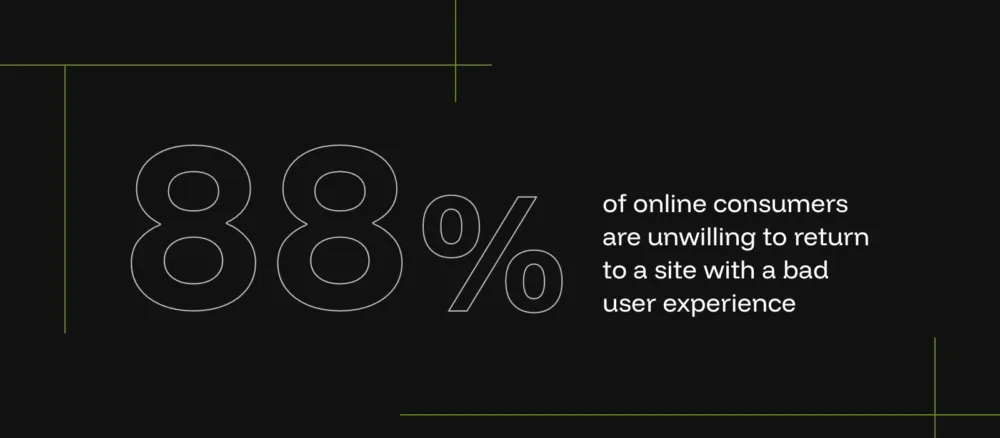
Without a conversion-focused website design, qualified leads click back to your competitors — and they’re not likely to come back. Research shows that 88% of online consumers are unwilling to return to a site with a bad user experience.
2. Poor content quality
Filling a website with content is the bare minimum. But with over 1.5 billion websites vying for attention in 2026, “good enough” content won’t convert.
Poor quality content checks a box but lacks substance. It’s generic, brimming with jargon and promises that any brand could make. Headlines don’t hook, and paragraphs drag. Website messaging feels inconsistent in tone, structure or target audience.
In any case, low-quality content makes users work to understand your value. But most hesitate to take on that headache, leading to a website not converting.
3. Bugs, errors and performance issues
Beauty isn’t everything online. Strong visuals and sharp messaging might create just enough excitement to explore. But that momentum is fragile, and website usability issues stop users in their tracks.
Pages take their sweet time loading. Buttons hide broken links. Layouts don’t adapt to mobile devices. A bad user experience makes errors the expectation, turning curiosity into chagrin.
Poor functionality ultimately raises questions about reliability. If a brand can’t maintain its website, users wonder what else might be overlooked and whether it’s worth the risk.
4. Misaligned keywords
Keywords pull their weight. They gradually push pages up the results page — but it doesn’t mean much if your SEO strategy puts you in front of the wrong audience.
You might be showing up for broad search terms when your offer is more niche. Or you’re pulling users with informational intent, not transactional. Maybe your search terms were attainable at one time, but the competition has stiffened.
A misaligned keyword strategy contributes to a website not converting. It pulls in unlikely prospects, leading to low engagement, poor SEO rankings and, ultimately, wasted time.
“So, how can I improve my website’s conversion rate?”
That was a lot to take in. Now, you’re probably wondering “how can I improve my website?” We hear you loud and clear.
When facing the possibility of website usability issues or a bad user experience, we recommend the following steps:
1. Start with an audit
We want your budget to be spent wisely. As such, we recommend identifying the specific needs of your website before taking action.
A website conversion audit will allow us to take a deeper look at analytics. The metrics show us where users come from, what they engage with and where their journey stops.
Our in-depth analysis reveals the root cause of a website not converting, whether that’s the keyword strategy, functionality or content structure. From there, we propose the next steps that will fit your budget and timeline.
2. Make small updates
Clients like you have only one question in mind: “How can I improve my website?”
We respond with clear solutions that address website usability issues. Our recommendations vary by circumstance — but common updates include:
- SEO strategies. Our strategists research relevant yet attainable keywords for your site, ensuring you capture qualified leads.
- UX copywriting. Our copywriters craft clear, concise and on-brand content that guides users through your experience.
- UX design. Our designers create a conversion-focused website design that prioritizes usability — without sacrificing style.
- Technical updates. Our development team integrates the latest software and plugins on your site to boost speed, responsiveness and overall performance.
3. Explore a website redevelopment
Sometimes, simple updates won’t cover the core problem of a bad user experience. If that’s the case, our interdisciplinary team will take your website down to the studs and start from scratch.
Strategists clarify your objectives, such as increasing leads, improving user flow or driving purchases, and build a clear roadmap to help you get there.
Creatives translate this direction into design and copy that aligns with your brand and ensures a cohesive experience that prompts key conversion actions.
Developers then rebuild your site with clean, scalable code focused on speed, accessibility and ease of navigation.
By the end, we deliver a brand-new website that’s well worth the investment. Our work ensures your platform looks, sounds and functions at its best — clearing the way for more conversions over time.

Start the Conversation
You have a hunch that your website is not converting — but you don’t need a plan in place.
You just need a partner.
For over 30 years, Paradigm has fostered partnerships built on endless imagination and measurable impact. We craft conversion-focused website designs for ambitious brands, whether they’re iconic landmarks, fintech wizards or industrial innovators.
We’d love to take a look at your website. Start the conversation below.